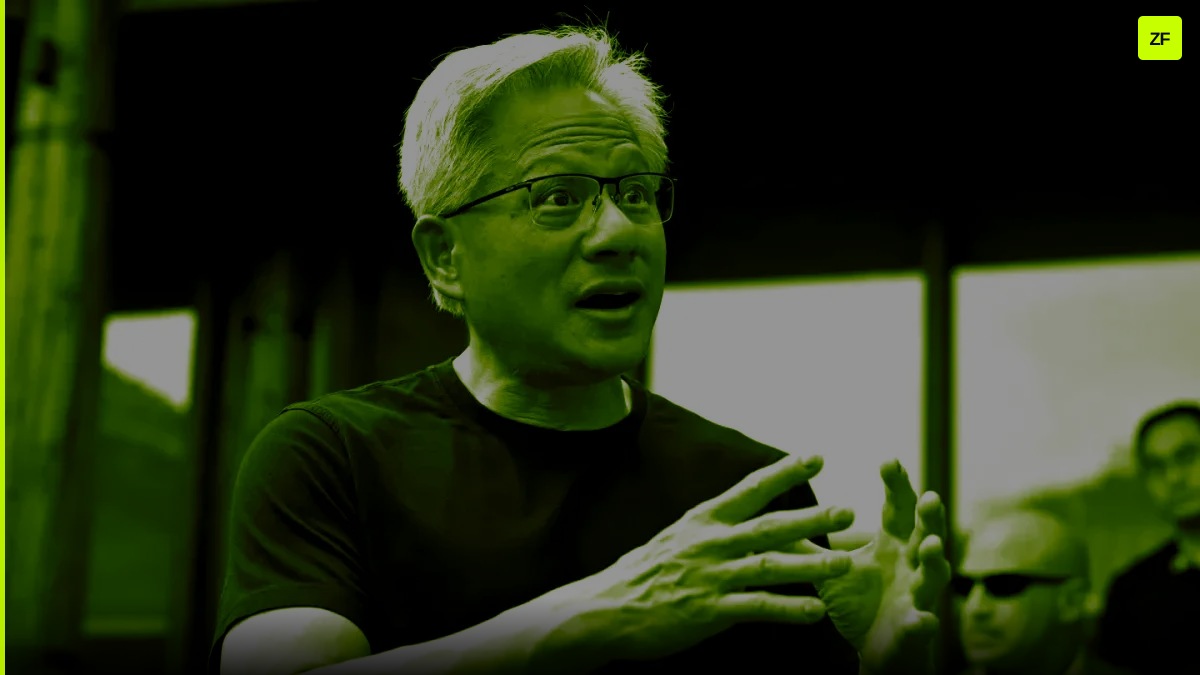
Jensen Huang did not set out to build the infrastructure of artificial intelligence. He set out to build better graphics chips for video games. That the GPU architecture NVIDIA developed for rendering 3D game worlds turned out to be precisely the computational structure required to train large neural networks is the most consequential technical coincidence in the history of computing — and Huang's genius was to recognise it before anyone else did, and to build accordingly.
The Accidental AI Infrastructure Company
NVIDIA's CUDA platform — the software architecture that makes NVIDIA's GPUs programmable for general computation — was launched in 2006 and initially attracted limited attention outside graphics and scientific computing. It was not until the 2012 ImageNet competition, when a deep learning model trained on NVIDIA GPUs outperformed every other approach in computer vision by a margin that shocked the research community, that the GPU's role in AI became clear. By that point, NVIDIA had been developing the hardware and software stack for GPU-accelerated computing for six years. Competitors were starting from zero.
This head start — in hardware architecture, in software development tools, in the community of researchers and engineers who had learned to program NVIDIA systems — created a moat that has proved extraordinarily durable. NVIDIA's market capitalisation, which stood at approximately $300 billion in early 2023, grew to more than $3 trillion within two years, making it briefly the most valuable company in the world. The growth was not driven by new products; it was driven by demand for existing products that the AI boom had suddenly made essential to every technology company on earth.
The Pick-and-Shovel King
The gold rush analogy for AI has been exhausted through overuse, but it applies with unusual precision to NVIDIA's position. In the California Gold Rush of the 1840s, the most consistently profitable businesses were not the miners but the suppliers of picks, shovels, and denim trousers. Whether any individual miner struck gold was irrelevant; as long as people were mining, they needed equipment. NVIDIA's position in AI is structurally similar: whether any individual AI application succeeds commercially is largely irrelevant to NVIDIA's business. As long as AI models are being trained, the GPU clusters needed to train them must be purchased.
For Zero Human Company operations, NVIDIA's position has specific implications. The cost of AI inference — the computational cost of running a trained model to produce outputs — is the dominant variable cost in most autonomous AI deployments. The economics of ZHC operations depend, more than any other single factor, on the trajectory of inference cost per query. And that trajectory is determined by hardware efficiency improvements that NVIDIA controls through its product roadmap. The H100, H200, B200, and successive generations represent the price-performance curve on which all autonomous AI operations planning must be based.
Huang's Architectural Vision: The AI Factory
Jensen Huang's public framing of the AI opportunity has evolved consistently toward a concept he calls the "AI Factory" — a data centre architecture in which every layer of the stack, from chip to networking to software, is co-designed and co-optimised for AI workloads. The traditional data centre was designed around general-purpose computing: flexible, programmable, suitable for almost any task at reasonable efficiency. The AI Factory is single-purpose: it is designed exclusively to train and run large neural networks, with every design decision made to maximise throughput on that specific task.
NVIDIA's DGX systems — integrated AI computing platforms that combine hardware and software in a pre-validated package — and its NVLink networking technology are the physical manifestations of this vision. The ambition is to make deploying AI infrastructure as straightforward as deploying standard servers: reliable, supported, and scalable without requiring deep hardware expertise.
For enterprises building ZHC infrastructure, this matters because the capability gap between organisations with premium AI computing infrastructure and those using commodity alternatives is growing, not shrinking. The largest AI models — which produce the most capable autonomous agents — require the most advanced hardware to run economically. As autonomous operations mature, access to high-performance AI infrastructure will become a competitive differentiator equivalent to broadband internet access in the early 2000s.
The Networking Layer
NVIDIA's acquisition of Mellanox in 2020 — the high-speed networking company whose InfiniBand technology connects the GPUs in large AI clusters — was, at the time, seen as a modest diversification. It is now recognised as a critical piece of the AI infrastructure stack that NVIDIA controls. Training a large AI model on thousands of GPUs requires that those GPUs communicate with each other at extremely high bandwidth. The networking layer that enables this communication is as essential as the GPUs themselves — and NVIDIA's ownership of both gives it an integration advantage that pure-play GPU or networking competitors cannot match.
What Boards Should Watch
The most consequential near-term development in NVIDIA's roadmap is not a new GPU but a new architecture: Blackwell, NVIDIA's platform for "reasoning AI" — the inference-optimised infrastructure for running the complex, chain-of-thought AI models that are becoming the standard for autonomous business operations. If GPT-4 represented a first generation of capable AI and o3-class reasoning models represent the second, Blackwell is the hardware infrastructure designed for the second generation. The inference economics of autonomous AI operations will be substantially determined by how quickly Blackwell scales.
NVIDIA's Omniverse platform — its simulation environment for training AI in synthetic data — is less widely discussed but potentially as significant. Training autonomous AI agents in physical simulations before deploying them in real environments is a methodology that has proven effective in robotics (Tesla Optimus, Boston Dynamics) and is now extending to autonomous software agents. The companies that can most efficiently generate training data for complex autonomous tasks — using simulation rather than real-world data collection — will have a significant advantage in deploying capable ZHC operations.
Jensen Huang is not building AI applications. He is building the infrastructure that makes all AI applications possible. Every autonomous operation running today, and every one that will be deployed in the next decade, runs on hardware from the company he has led for thirty years. Understanding NVIDIA's technology roadmap is, in a meaningful sense, understanding the capability trajectory of autonomous operations generally.