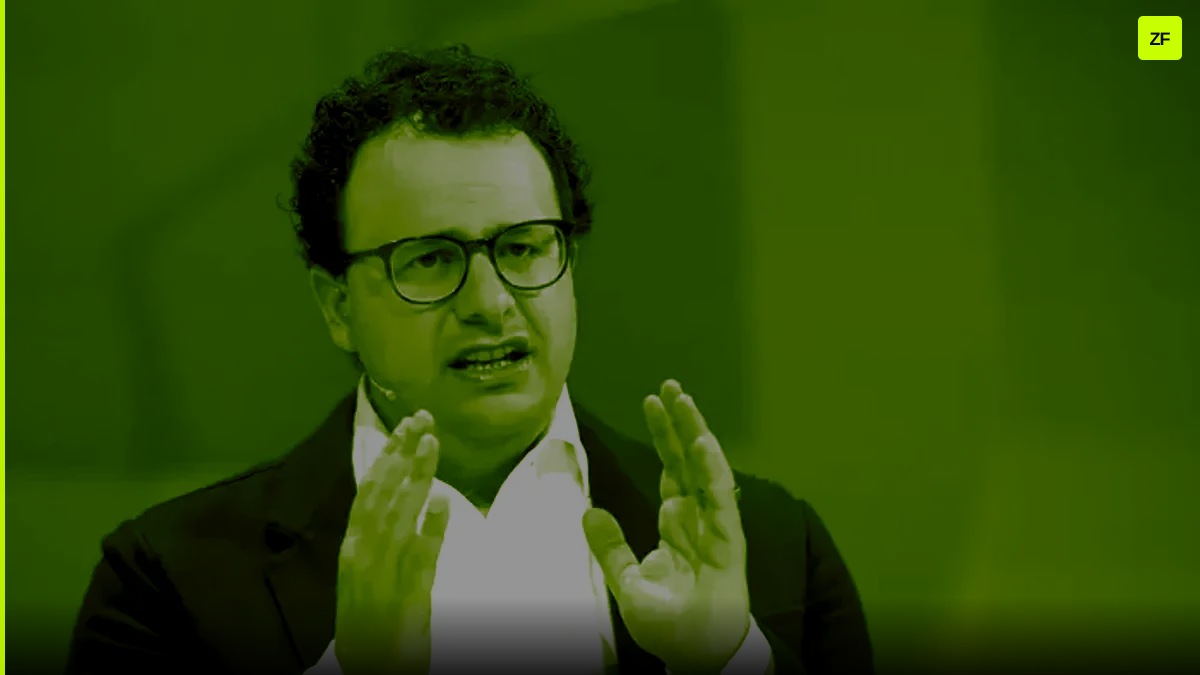
If Elon Musk represents the aggressive frontier of the Zero Human Company thesis, Dario Amodei represents its most intellectually rigorous examination. The co-founder and CEO of Anthropic is the only major AI laboratory leader who has published a sustained, evidence-based analysis of what artificial general intelligence might actually do to human civilisation — and who uses that analysis to inform a commercially distinct strategy built around the proposition that safety and capability are not trade-offs, but the same thing.
The Business
Anthropic reached a $61.5 billion valuation following its 2024 funding rounds, having raised more than $9 billion in total investment. Amazon is its largest strategic partner, with a $4 billion commitment and deep integration between Claude and Amazon Web Services' Bedrock platform. Google has invested an additional $2 billion. The structure places Claude inside the cloud infrastructure operated by the two dominant enterprise cloud providers — meaning the majority of Fortune 500 companies can access Anthropic's models without additional vendor procurement processes.
Claude 3.5 Sonnet, released in mid-2024, achieved benchmark performance that surpassed GPT-4o on multiple coding and reasoning evaluations, establishing Anthropic as a credible alternative to OpenAI in enterprise AI procurement. Claude 3.7 Sonnet, released in early 2026, introduced extended thinking capabilities — deliberate multi-step reasoning — that makes it competitive with OpenAI's o-series models on complex analytical tasks requiring sequential logic. Annual recurring revenue is estimated at $1.5–2 billion, growing rapidly.
Anthropic employs approximately 1,000 people, making it unusual among companies of its valuation for the degree to which it has maintained research concentration over commercial scale. The headcount is deliberate: Amodei's view is that the most consequential work in AI is done by small, high-density teams, and that premature scaling into sales, marketing, and support creates organisational drag before the product is ready to support it.
The Vision
Amodei's vision is articulated most explicitly in his October 2024 essay, Machines of Loving Grace — a 15,000-word argument that AI, developed responsibly, could compress decades of scientific progress into years. The specific claims are deliberately concrete: a 100-fold acceleration in biological and medical research, enabling the defeat of most infectious diseases within five years of AGI; breakthroughs in mental health treatment; economic growth compressing a century of development into a decade.
The commercial strategy is built around a precise premise: safety is not a constraint on capability, it is a distribution advantage. Constitutional AI — the methodology Anthropic developed for training Claude to reason about ethics, flag harmful content, and explain its uncertainty — is not positioned as a limitation on what the model can do. It is positioned as the engineering property that makes enterprise deployment survivable in regulated industries where legal, compliance, and reputational risk would otherwise make AI adoption impossible.
The strategic logic is working: Anthropic's penetration in financial services, healthcare, and legal services — industries with high regulatory exposure — is significantly stronger relative to its overall market share than any competitor. Claude is the AI layer that compliance departments will greenlight.
In Their Own Words
"We believe we may be building one of the most transformative and potentially dangerous technologies in human history, yet we press forward anyway. This isn't cognitive dissonance but rather a calculated bet — if powerful AI is coming regardless, Anthropic believes it's better to have safety-focused labs at the frontier than to cede that ground to developers less focused on safety."
— Anthropic Core Views document
"I want to try to describe what I think could actually happen if AI development goes well in a serious way, taking seriously the possibility that AI will be able to perform tasks far beyond current human capabilities."
— Machines of Loving Grace, October 2024
"The question isn't whether AI will be transformative. It's whether we'll retain enough institutional capacity — in government, in business, in civil society — to manage the transition well."
— World Economic Forum, Davos, January 2025
"I think within the next few years we will build AI systems that are genuinely transformatively powerful — able to accelerate scientific progress, run complex organisations, and do things we currently consider to require human expertise."
— Lex Fridman Podcast, 2024
The View from the Boardroom
Among enterprise technology procurement professionals and capital markets analysts, Amodei has cultivated a distinct and valuable reputation: the AI CEO most worth taking seriously on risk.
CAPITAL MARKETS
"Amodei's strategic insight — that safety is a distribution advantage, not a handicap — has been validated by enterprise procurement data. Fortune 500 legal and compliance teams are significantly more willing to greenlight Anthropic deployments than most alternatives. In regulated industries, that is a durable, compounding competitive moat."
— Sequoia Capital, partner analysis, 2025
CLOUD INFRASTRUCTURE
"The Anthropic-Amazon relationship is significantly underappreciated by most observers. AWS has committed $4 billion and is building direct integrations into the cloud infrastructure that runs a substantial share of global enterprise computing. This is not a vendor contract. It is a structural dependency that compounds with every workload migrated to Bedrock."
— Goldman Sachs Technology Equity Research, 2025
AI GOVERNANCE
"Machines of Loving Grace is the only publicly available document from a major AI laboratory CEO that treats AGI as a near-term operational planning problem rather than a distant philosophical thought experiment. Boards responsible for 10-year strategic plans should read it before approving their next AI roadmap."
— Harvard Kennedy School, Belfer Centre for Science and International Affairs, 2025
The principal challenge raised by strategists is valuation sustainability. Anthropic's $61.5 billion valuation implies a revenue multiple that requires the company to capture a substantial share of a market still forming. The Amazon and Google bets are structural hedges — both cloud giants are effectively paying for insurance against OpenAI dominance — but that insurance has a horizon, and Amodei will need to convert safety positioning into durable revenue growth to justify the price.
The ZHC Verdict
Amodei's contribution to the Zero Human Company thesis is primarily architectural rather than operational. He has not run autonomous operations at Musk's industrial scale, and Anthropic is itself a conventional knowledge-work organisation. But the significance is structural: Claude is the AI reasoning layer being embedded in the enterprise workflows of thousands of organisations that would not deploy less safety-verified alternatives. Every operator using Claude to automate analysis, correspondence, contract review, regulatory compliance, or customer interaction is executing a version of the ZHC thesis — and Amodei's constitutional AI methodology is what makes those deployments defensible in front of a board's audit committee.
The long-term ZHC question is whether Amodei's careful, safety-grounded approach to AGI actually produces the transformative capabilities he describes in Machines of Loving Grace before more aggressive competitors reach them first. If it does, Anthropic will have proven that the responsible path and the fastest path to AGI are the same. That outcome would be, by any measure, the most commercially significant event in AI history.
ZHC Readiness Score: 7/10. The enabling infrastructure for enterprise ZHC adoption — building the AI layer that regulated industries will trust, deliberately and without shortcuts.