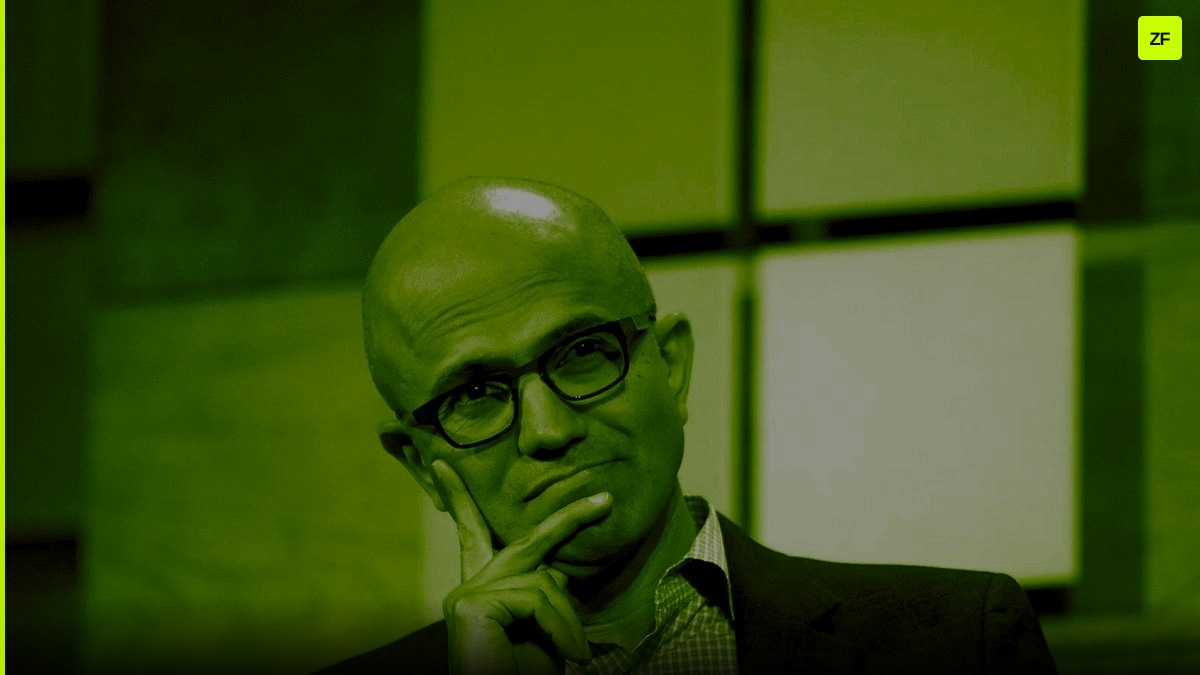
When Satya Nadella committed Microsoft to an initial $1 billion investment in OpenAI in 2019, followed by $10 billion in 2023 and further commitments that may reach $100 billion total, he was making the largest concentrated technology bet since Microsoft's original Windows platform investment in the early 1980s. The bet is paying out. Copilot — Microsoft's AI integration across its enterprise software suite — is the most widely deployed enterprise AI system in the world, embedded in the productivity tools used by hundreds of millions of knowledge workers daily. For boards evaluating the practical implementation of ZHC-style operations, Nadella's Microsoft is the reference case.
The Transformation Before the AI Transformation
To understand Nadella's AI strategy, it is necessary to understand the transformation he executed before AI became the dominant technology narrative. When Nadella became CEO in 2014, Microsoft was widely considered a declining force in technology — a company whose core Windows and Office franchises were being disrupted by mobile operating systems and cloud-native software, whose internal culture was described as politically toxic by former employees, and whose product quality had deteriorated visibly through the Ballmer era.
Nadella's first transformation was cultural: a shift from what he diagnosed as a "know-it-all" culture to a "learn-it-all" culture. His second transformation was strategic: the decision to embrace cloud computing — specifically Azure — as Microsoft's primary growth platform rather than defending the on-premise Windows infrastructure that had made the company its fortune. These two transformations, executed over five years, created the organisational capability and cloud infrastructure that made the OpenAI partnership possible. Without Azure as a deployed cloud platform and without the cultural change that made Microsoft's engineers willing to work with outside technology partners, Nadella could not have executed the OpenAI integration that has since defined his legacy.
Copilot and the Enterprise AI Interface
Microsoft's Copilot suite — embedding AI assistance into Word, Excel, PowerPoint, Teams, Outlook, and the Windows operating system itself — is, in structural terms, the largest enterprise AI deployment in history. The strategic logic is straightforward: Microsoft already has the most deeply embedded position in enterprise software, with Office productivity tools used in the majority of large organisations worldwide. Adding AI capability to tools that knowledge workers already use daily, without requiring them to adopt new workflows or new applications, eliminates the primary adoption friction that limits AI deployment in enterprises.
The ZHC implications of this strategy are significant and underappreciated. Copilot does not, in its current form, automate business operations. It assists knowledge workers in performing their existing tasks more efficiently. But the capability trajectory — from assistant to collaborator to autonomous operator — is baked into Microsoft's product roadmap. Copilot Studio, Microsoft's platform for building custom AI agents for specific business processes, is the current expression of this trajectory: enterprises can build agents that autonomously monitor data feeds, generate reports, process requests, and execute workflows, all within the Azure and Microsoft 365 infrastructure they already operate.
Azure AI and the Enterprise Platform Play
Microsoft's AI infrastructure strategy is distinct from both OpenAI's and Anthropic's. Rather than competing in the foundation model race — Microsoft invests in that through its OpenAI partnership but does not develop frontier models independently — Nadella's strategy is to be the enterprise deployment platform for whatever models enterprises choose to deploy. Azure AI offers OpenAI models, Llama models, Phi (Microsoft's own small language models), and third-party models through a single enterprise-grade cloud platform with the security, compliance, and integration capabilities that enterprise IT organisations require.
This multi-model, platform-neutral strategy is, commercially, extremely astute. Enterprise AI adoption is not converging on a single model; different use cases require different model capabilities, and the frontier is advancing rapidly enough that model selection must remain flexible. Azure AI's platform architecture allows enterprises to adopt and switch models as the frontier evolves without rebuilding their AI infrastructure from scratch. For organisations building ZHC operations on Azure, this means the investment in platform infrastructure is more durable than investment in any specific model capability.
The Productivity Data Opportunity
Microsoft's unique advantage in enterprise AI is data — specifically, the vast quantities of organisational productivity data generated through Office 365, Teams, and other Microsoft services. An AI system that understands an organisation's document archive, email patterns, meeting structures, and workflow processes can provide contextually relevant assistance and autonomous capabilities far beyond what general-purpose AI models can achieve. Nadella has been careful in public about how explicitly he discusses Microsoft's data advantage, but it is the structural moat that makes Copilot defensible against OpenAI products that do not have the same organisational context.
For boards considering ZHC implementations, this data advantage argument generalises: the AI systems that will be most effective in your specific operational context are those that have access to your specific operational data. This is the argument for building on platforms that can be fine-tuned and customised with proprietary data, and for investing in the data infrastructure — clean, well-governed, accessible — that makes AI customisation possible. Microsoft's Copilot roadmap is effectively a demonstration of this principle at enterprise scale.
The Anthropic Counterbalance
Microsoft's strategic dependency on OpenAI — and the governance instability that was dramatically demonstrated by the November 2023 board crisis — has led Nadella to make investments in alternative AI providers, most notably Mistral and Cohere. Microsoft's Azure platform hosts models from multiple providers precisely because platform neutrality reduces concentration risk. For enterprises building ZHC operations on Azure, this multi-provider architecture is a feature rather than a limitation: it provides optionality as the AI capability landscape evolves.
What Boards Should Watch
Microsoft 365 Copilot adoption metrics — specifically, enterprise licence penetration and active usage rates — are the most reliable near-term indicator of enterprise AI adoption velocity in knowledge work. Early data suggests that Copilot adoption is slower than Microsoft initially projected, with usage rates varying significantly by user segment and use case. Understanding what drives high versus low Copilot adoption within organisations is currently the most practically useful research available on enterprise AI implementation, and Microsoft's public commentary on adoption patterns deserves close attention.
Microsoft's investment in AI infrastructure — data centres, power agreements, networking — is on a trajectory that will make Azure one of the largest AI computing platforms in the world within three years. For enterprise organisations planning ZHC operations at significant scale, understanding the Azure AI infrastructure roadmap — specifically the availability and pricing of high-performance inference capacity — is essential input to multi-year operating model planning.
Nadella's insight — that the path to enterprise AI dominance runs through the tools that knowledge workers already use, not through convincing them to use new ones — is the most practically useful strategic principle for any enterprise building its own ZHC adoption roadmap. Meet users where they are. Build AI into existing workflows before disrupting them. The transformation follows from adoption; adoption follows from minimum friction.